I’ve known about post formats for years, and I’m only now actually using them.
That came up last week when I jumped back in with Bob Dunn on Open Channels FM for Post formats, bring back the fun and flexibility in blogging. It was my first episode back from sabbatical, and I told Bob that I spent a lot of those three months thinking about writing. Woodworking, house remodeling, tons of time with my family, and all those things swirling around, and I kept asking myself the same thing: how do I document this? Writing is the thing that kept coming back to me.
So when Bob suggested we talk about post formats, I was in. They’re one of the things that has helped me publish more consistently this year, and it turns out Bob has been finding the same thing on his own blog.
What are post formats?
I do all my blogging and writing in WordPress. If you’ve followed WordPress over the years, classic WordPress had these things called post formats. They were a way for you to organize your content around the mode of communication.
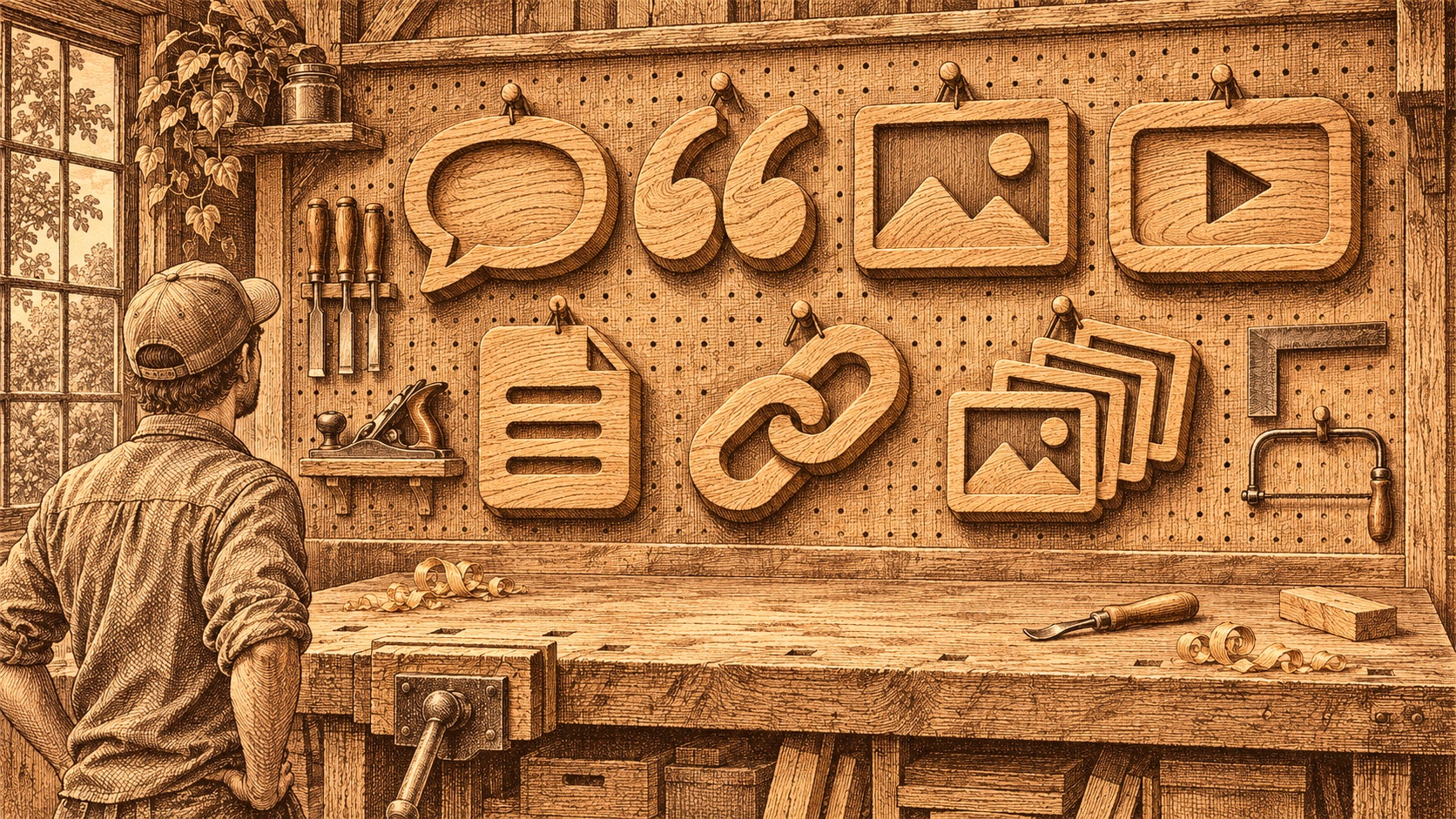
Typically, people think about blogging and they think about long-form writing. Is that a 500, 1,000, or 2,000-word essay? Sure, it could be, but that’s your standard post. Post formats give you other options, such as1:
- Status: Much more like a social media post. If you were going to post it on Facebook, X, or Instagram, it’s a status.
- Quote: Something someone said that you want to hold on to.
- Link: Literally a link I found on the internet, but I want it on my blog so I can follow it, track it, search it, and have a history of it.
- Image and gallery: Hey, I got a photo. Boom, post format.
A lot of people used these, and still do to this day, to create something like a digital garden. Not everything has to be polished and ready for a magazine or print publication, or headed out to an audience of critics. It’s just, hey, here’s this thing I thought about today. Quick status, post, done.
They’re different types of content that can all live on one blog, which I think is really fun to think about.
Why did post formats disappear?
Then came block themes. Classic WordPress had PHP-templated themes; block themes modernized WordPress so people could edit any part of their site. But one thing that got lost in that transition was post formats. WordPress became much more of a website builder as opposed to a writing and publishing platform. It still did all of those things, but post formats weren’t the primary direction, at least from a theming perspective.
And theming matters here. A theme is what displays your formats in unique ways. If I have a gallery post with a bunch of photos, I want that to look different than my blog post. If I have a quote post, I want that to look different than my status update.
Courtney Robertson built a plugin, Post Formats for Block Themes, that brings classic post formats into modern block theming. It’s part of what inspired me to dig into this a little more as I built my own theme. It’s a fantastic plugin, and a nice way to bring post formats back into your daily writing habit, or weekly, however often you write.
Bob’s using it too. Somebody recommended it to him when he started his personal blog back up, and that’s how he set the whole thing up.
Why did I start using post formats?
Here’s where post formats actually changed something for me.
Even knowing about them for a long time, I had the same struggle Bob described: oh, I’ve got to write this super polished essay. I had this sort of self-diagnosis of, well, if I don’t perform well, I’m not going to show that I have this writing background.
I needed to get rid of all of that. Who am I writing for? I’m writing for me. Do I want people to read my stuff? Yeah, that’s always going to be there. But first and foremost, I see myself as the audience, and I don’t want to lose track of a thought I had.
Bob put it this way, talking about the personal blogs and podcasts he’s started over the last few years:
I’ll start it and it just ends up sitting there, or I just don’t do anything, because I’m always thinking, oh, I gotta create this content for it. And I always had it pigeonholed to be a certain kind of content.
Bob Dunn
That pigeonhole is the whole problem. If the only thing that counts as a post is an essay, then every post costs an essay’s worth of effort, and most days you don’t have that. So you don’t post.
Chuck Grimmett said it best: just hit publish. A personal blog is low stakes. It doesn’t need a polished essay or a groundbreaking idea; a link, a quote, or a few notes about a hobby are plenty.
Post formats take that cost away. Real quick, post format update, done, and now it’s there. It’s more self-gratifying in the moment, as opposed to that external gratification I’m trying not to want as much anymore.
Bob’s been posting almost every day since he started using them:
It’s no longer a barrier for me. It’s not like, oh, what am I going to write my post today? It’s like I just suddenly have this thought or this photo to share or something, and I’d rather have it there than feed the machine somewhere else on a walled garden platform.
Bob Dunn
He even told me he’ll be on X, think of something to say, and go put it on his blog instead. People think he’s insane. I think he’s onto something.
Why does it matter what my blog looks like?
The other half of this, for me, is that I have full control over what that content looks like.
I built my own block theme, Tufte Blocks, based on the work of Edward Tufte, who I studied in grad school. Somebody had made Tufte CSS, and I thought, oh my gosh, I love Edward Tufte, but there’s no block theme. This is just a CSS framework, and I use WordPress. So I built one. It’s open and free on GitHub, so anybody can try it. I orchestrated Claude Code and Codex to build what I wanted; I could have done it myself, it just would have taken me a lot longer to get there.
On my site, anything that isn’t a standard post becomes a note: no title, no featured image, and it stays out of the main blog loop and the newsletter.2 My statuses, photos, and galleries get to be quick and light, living right next to my longer essays without competing with them.
That’s the part about owning your blog that’s so satisfying. I’m not falling into the sameness of platforms. I tried Substack for a while, and even with all the colors and layouts they give you, everybody’s Substack looks familiar. My blog doesn’t look like anybody else’s because I crafted it.
Bob took this somewhere fun. He named all of his categories after hats. Fedora is for his more serious posts. Party hat is for celebrations. There’s a thinking cap, too.
It also gives me a little bit of guidance and a little bit of fun when I’m writing a post, because now I think, oh, what category am I going to put this under?
Bob Dunn
I love that. It’s the kind of thing you’d never get to do in a social feed, and it’s exactly what Bob meant when he brought up making the internet weird again.
How can I get started?
I wrote3 recently about why we aren’t all blogging, and lowering the bar for what counts as a post kept coming up. Post formats are the most practical way I know to do that in WordPress. One photo is a post. A short thought is a post. A link with a sentence about why you liked it is a post.
And the more of those you publish, the less each one weighs. That’s how I’m finally getting consistent; letting the small stuff count.
Bob said something near the end of our conversation that I keep thinking about:
I don’t know if anybody is paying attention to it, but I share the stuff and I just go in there and do my little thing every day.
Bob Dunn
That’s the mindset. If somebody finds it and gets value out of it, great. If not, you still have it.
If you’re listening to the episode or reading this and want to get started but don’t know where, find me. I’d love to help you get your first post out, or set up post formats on your own site.
So what’s the smallest thing you could post today?
- I only listed a few of the most common post formats. The full list and explanation of formats is detailed in the official WordPress documentation. ↩︎
- I could actually decide to send any post format as an email with Jetpack Newsletters. That flexibility of toggling email sending on or off is so nice. ↩︎
- When I say wrote, I mean I used the status post format. This is a great way to start building ideas for longer posts. ↩︎
Leave a Reply